Org-ASM Home Page
The Microprocessor Integrated Development System for the Macintosh

Last updated: 01 June 2015
Page Index:
Org-ASM Assembler
This is a set of files that will turn a Macintosh into an IDE for any microprocessor, now or in the future. Other software will be required too, mainly BBEdit, but Org-ASM may be run directly from any Shell, like the Terminal app.
Org-ASM is based on the popular Telemark Cross Assembler (previously known as TASM) which uses external table files to define the microprocessor type. This has been ported from DOS to UNIX and Atari platforms and a Macintosh MPW version was previously ported in 1998. As MPW runs under OS9 or Classic and all Macintoshes are Intel now and support neither, a new direct port from the UNIX version 3.2 has been made to OS 10.10 (Yosemite) and should run on all Intel Macs from OS 10.6 onwards.
Here is a screen shot of it running in a BBEdit Worksheet window:
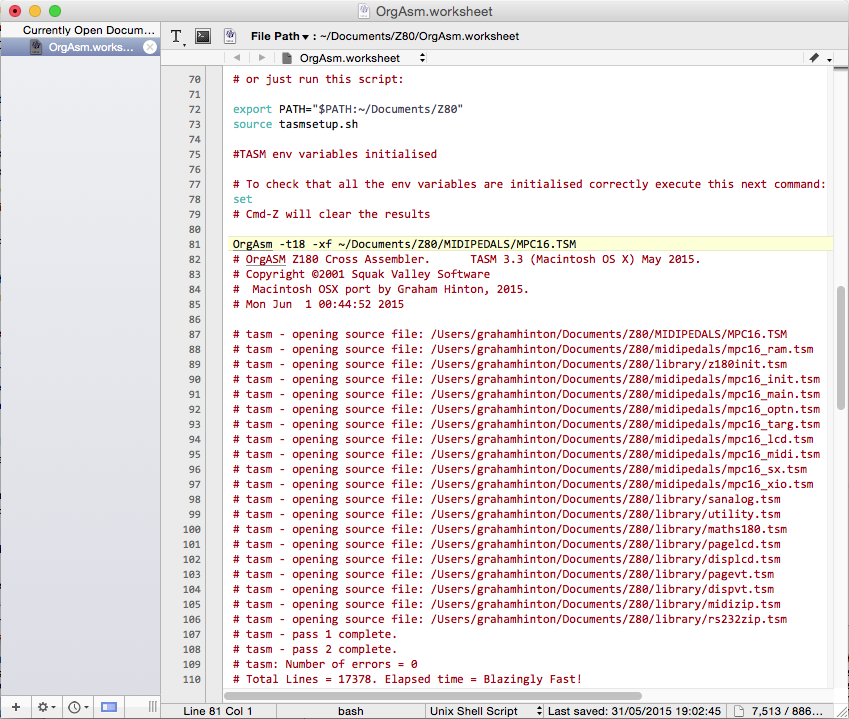
Any TASM files from other platforms (Unix, PC or Atari) may be brought over and used with little or no editing, just make sure that all line endings are Unix LFs. TASM also has definable directives that make it easy to port work done under other assemblers to it with the minimum of work. Files are provided to customise BBEdit for a fully integrated development system including syntax colouring for Z80/Z180 assembly language.
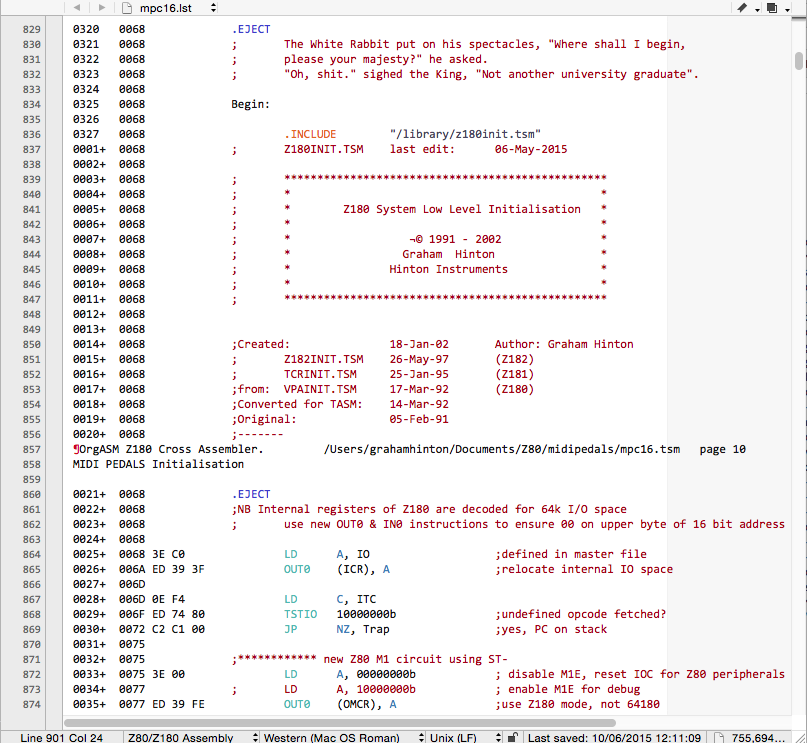
Here is an example of a listing output file viewed in BBEdit with syntax colouring:
Download Org-ASM - OS X Package (96KB)
Please double click on the archive to unzip the folder and then read the 'Read Me' file carefully as it contains instructions for the exact placement of all files and how to make the necessary changes to match the pathnames on your computer.
The package contains everything needed for a Macintosh IDE except an editor and the Shell to run it under. Tables are provided for the following microprocessor families:
- 6502 (R65C02, R65C00/21)
- 6800 (6801, 6803, 68HC11)
- 6805 (M146805 CMOS, 68HC02C4)
- 8048 (8041A, 8022, 8021)
- 8051
- 8085
- 8096 (80C196KC)
- Z80 (Z180/HD64180)
- TMS32010
- TMS320C25 (TMS320C26)
- TMS7000
Information to create your own tables may be obtained by paying the TASM shareware fee, see The TASM Home Page for this and other information.
Additional Macintosh Version FAQs
Q: What performance can be expected?
A: Blazingly Fast. The old cliche always claimed, but rarely true except in this case.
TASM used to time its execution in seconds and compute the lines/sec rate,
but it is often less than one second now even for large assembly programs.
Q: What compiler is used to build the released version of TASM?
A: XCode version 6.3.2 Apple LLVM 6.1
Q: What are the Macintosh version specifications?
A: Org-ASM 3.3 is ported directly from the UNIX TASM 3.2 so the specification is similar.
- Maximum number of labels: 15000
- Maximum length of labels: 32 characters
- Maximum address space: 64 Kbytes (65536 bytes)
- Maximum number of nested INCLUDES : 4
- Maximum length of TITLE string: 79 characters
- Maximum source line length: 511 characters
- Maximum length of pathnames: 511 characters
- Maximum length of command line: 511 characters
- Maximum number of instructions (per table): 1200
- Maximum number of macros: 1000
- Maximum number of macro arguments: 10
- Maximum length of macro argument: 16 characters
- Maximum number of files: 20
Needless to say, running this on the Macintosh is a lot less painful than trying to use a PC.
Q: What are the minimum system requirements to run OrgAsm?
A: A minimal Mac with the Terminal app and a text editor, but it will be much better with BBEdit vers 11.
- A Macintosh computer with an Intel CPU
- A hard disk with at least 20 - 40 Mb of free space
- OS X 10.6 or later
- BBEdit version 10 onwards
In other words not a lot and virtually any Macintosh bought in the last five years would be adequate. The Org-ASM Tool is only 73KB in size.
Q: Will Org-ASM run under earlier OS X version?
A: Org-ASM previously ran as an MPW Tool on 68k and PPC Macs.
This version can be still used on older Macs and the source code will be compatible.
Information on Macintosh Programmers Workshop is on Wikipedia
Other Macintosh Applications for Microprocessor Development
- Bare Bones Software - BBEdit the Swiss Army Chainsaw of Programmers' Editors.
- Serial - excellent terminal emulator needed to send object files to device programmers
- FTDI USB Cables - needed to make serial ports. Replace the OS drivers with the latest from here.
- Osmond - PCB Layout application written by a rocket scientist.
- Capilano Computing - DesignWorks: Schematic & Simulation CAD software. Sadly in need of debugging and revising after 25 years.
- MPLAB®X - Microchip's IDE for PICs which took them long enough to produce a Mac (read Java) version.
Acknowledgements
First and foremost to Tom Anderson for writing the Telemark Cross Assembler.
BareBones Software for BBEdit and implementing an MPW style Worksheet for running shells. (Why didn't Apple provide that?)
Return to Hinton Instruments' Home Page
All material on these pages Copyright ©1998-2015 Hinton Instruments.
The name Org-ASM has been used on this page to attract less traffic from wankers in the Middle East.